Choral Scholarships at Trinity
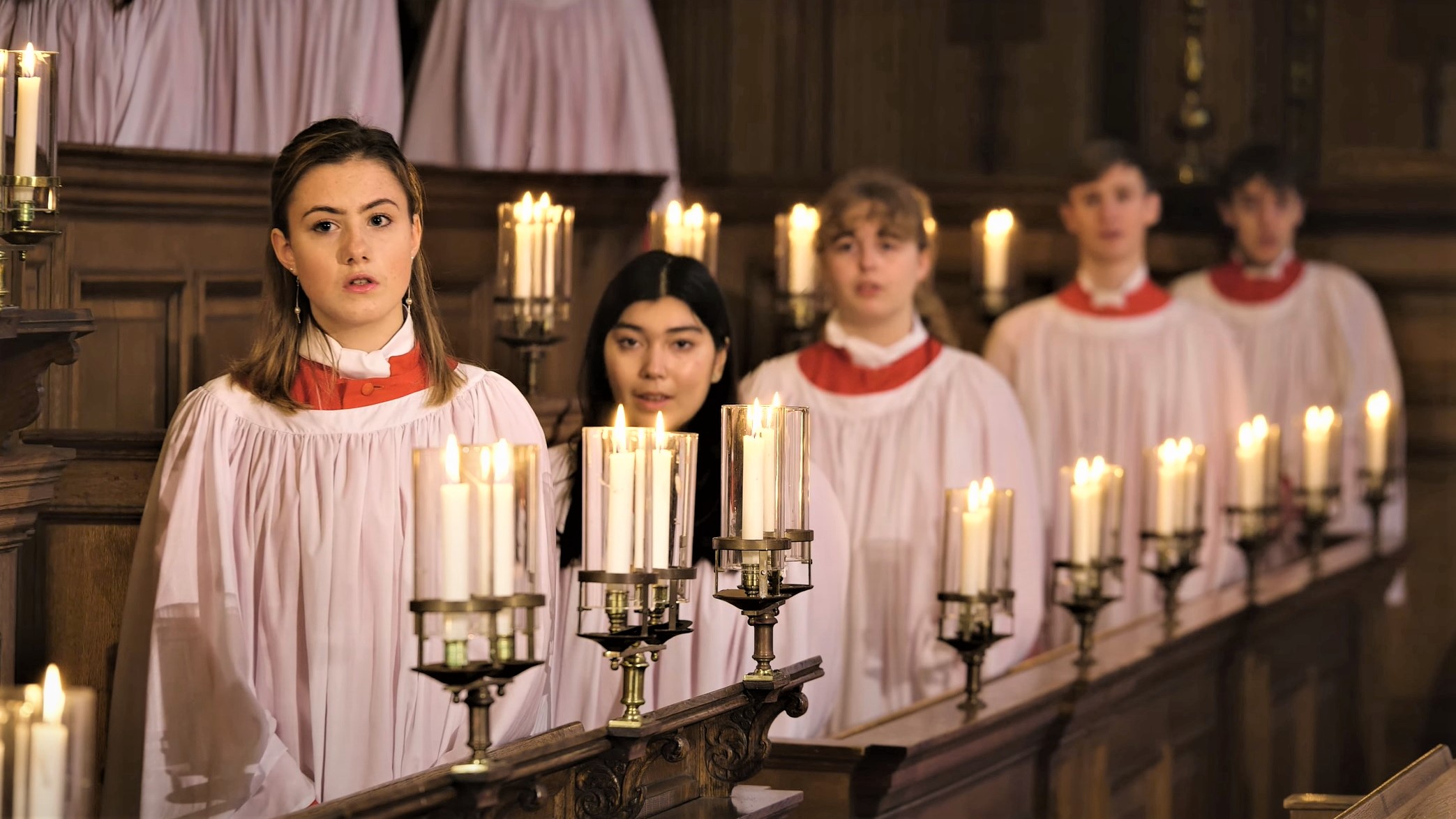
Choral Scholarships at Trinity College combine the singing of weekly services in the Chapel with an exciting schedule of recordings, concerts and international tours outside term.
The primary duty of a Choral Scholar during term is to sing at the three services of Choral Evensong that take place each week, together with occasional special services. Music of all eras is sung and, in recent years, the Choir has collaborated with a number of contemporary composers and given several world premiere performances. All choral services are > webcast live from the Chapel and available to listen again.
Outside term, the Choir enjoys a programme of high-profile performances and recordings, regularly working with top orchestras such as the Orchestra of the Age of Enlightenment and the City of London Sinfonia, and with leading professional soloists.
Although Choral Scholars must balance this commitment with their own degree, they invariably find time to pursue other activities. Choir members can be found directing plays, playing sports, performing in operas or close harmony groups, giving solo recitals and much more besides. Trinity has a thriving College music scene and excellent music facilities – Trinity College Music Society organises around 30 concerts a term. After graduating, many Trinity Choral Scholars go on to high-profile careers in music.
The Choir is socially rich and diverse, partly due to the range of academic subjects read by Choral Scholars – Music, Maths, Natural Sciences, Engineering, Law, Theology, English, Classics, Modern & Medieval Languages – and also influenced by the participation of UK and international postgraduate students.
How to apply
Anyone interested in finding out more about Choral Scholarships at Trinity is invited to write to us at:
Meet the Choral Scholars
Read our Q&As with three Choral Scholars to find out more about their experience of being in the Choir, and how they manage the commitment alongside their studies and other activities.
We also encourage prospective Choral Scholars and Organ Scholars to read our > Myths & misconceptions page, which deals with a number of common beliefs and stereotypes.
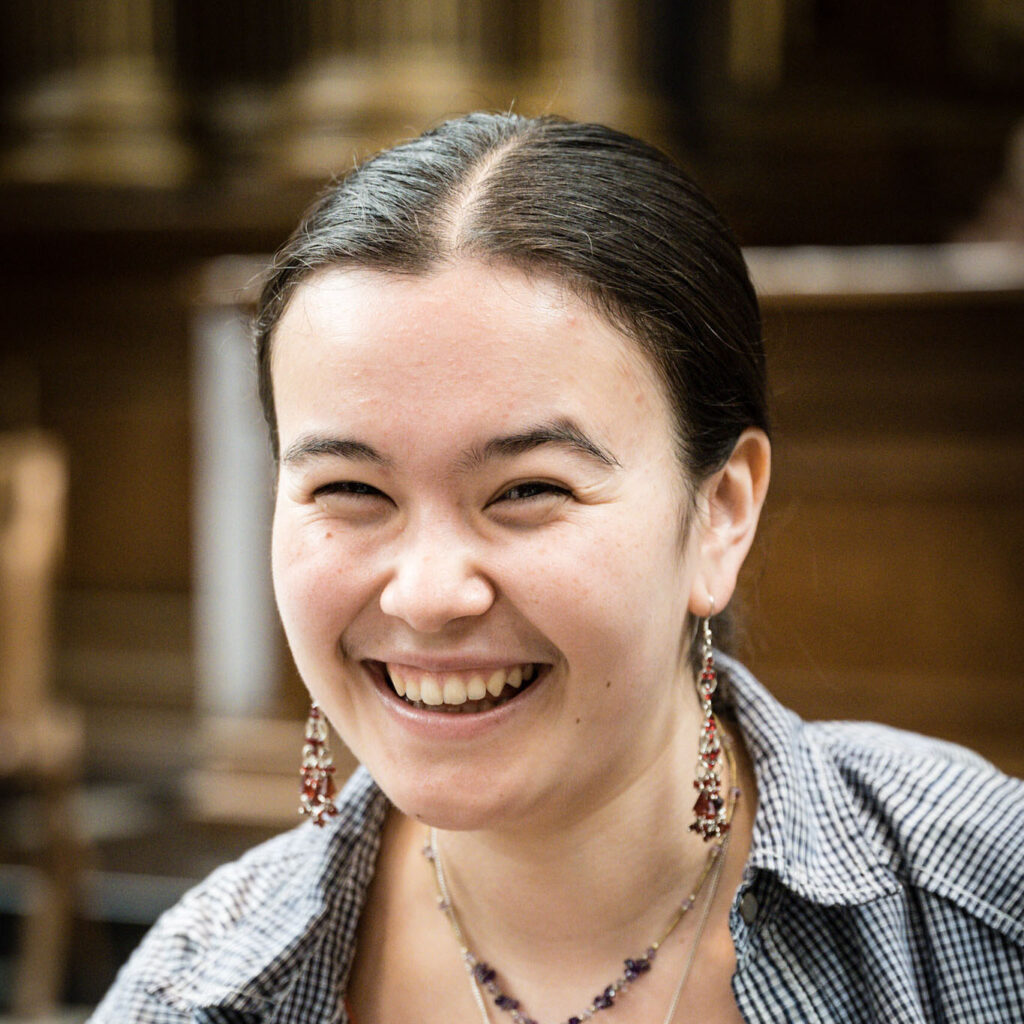
Sumei
“I would be lying if I didn’t say that the best part of TCC is the feeling of community.”
Read our Q&A with Sumei
What do you enjoy most about being in TCC?
Although it’s very cliché, I would be lying if I didn’t say that the best part of TCC is the feeling of community. We spend a lot of time with each other, but there’s never a moment where I wish I was anywhere else. The high standard of singing is obviously a plus too, and I feel very privileged to be able to work with such incredible musicians on such a frequent basis.
How do you find the commitment of being a choral scholar alongside your academic study?
Being in choir does take up a fair amount of time, but in all honesty, as it’s at regular slots each week, it’s never been a strain on my academic work. The regularity makes it very easy to plan when to do things, whether that’s work, practice, or meeting up with friends. I’ve also been able to do a lot of other extracurricular activities (opera, acappella, musical theatre, yoga, lacrosse…) so being a choral scholar really doesn’t prohibit you from doing other things you’re passionate about!
What has been your musical highlight of being in TCC?
The year I joined choir was the Covid year, but despite obvious logistical limitations, we were able to spend two weeks recording in Norfolk over the summer. We camped in tents, played tennis, badminton, cricket, and croquet, had a jazz night and a quiz night, all while recording a disc of Ivo Antognini in a beautiful church!
Sumei was interviewed in her second year at Trinity (Summer 2022) when she was reading Languages (French and Spanish).
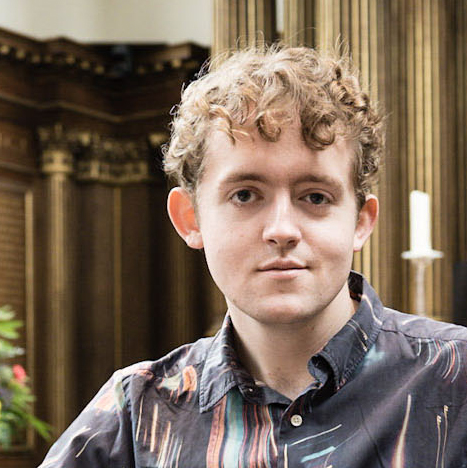
Benedict
“Being in TCC also acts as a gateway for other opportunities, such as opera and concerts.”
Read our Q&A with Benedict
What do you enjoy most about being in TCC?
I think this has to be the community within the choir – you essentially get a free social circle of people across different years, subjects, and colleges. TCC usually come up early at the start of the year to rehearse, so you have a week or two to get to know everyone without the stress of term. This also gives you a head-start compared to other freshers on getting settled in. The singing itself is also a great relief from academic work; because we often rehearse the harder repertoire before term, sessions within term are usually quite low stress. Choir gives you a time where you can leave all your outside worries and work at the chapel door and just concentrate on the music.
How do you find the commitment of being a choral scholar alongside your academic study?
I never really had an issue with this. The Cambridge workload is fairly heavy but not outrageously so – you’re certainly not expected to work all hours of the day. In my experience, energy rather than time is the limiting factor, which if anything, singing restores. Also, many choir members perform well in exams, suggesting that there isn’t a significant conflict – Choir may even help by structuring some time in the week where you simply don’t have the mental capacity to think about work.
What has been your musical highlight of being in TCC?
Facetious answer: whatever we’re singing at the moment. We’re lucky in Trinity that we usually sing very good music to a high standard. Being in TCC also acts as a gateway for other opportunities, such as opera, smaller student-run services in Trinity, and concerts. For example, many of the choir recently sang ‘Spem in alium’ in such a concert put on by TCMS (Trinity College Music Society) and performed
under the Wren Library. Across all this, I’d have to say that the highlight so far has been singing Brahms’ Ein Deutsches Requiem with piano; the version for four hands piano allows the choir to sing with much more intimacy and subtlety than with the full orchestra version.
Benedict was interviewed in his second year at Trinity (Summer 2022) when he was reading Maths.
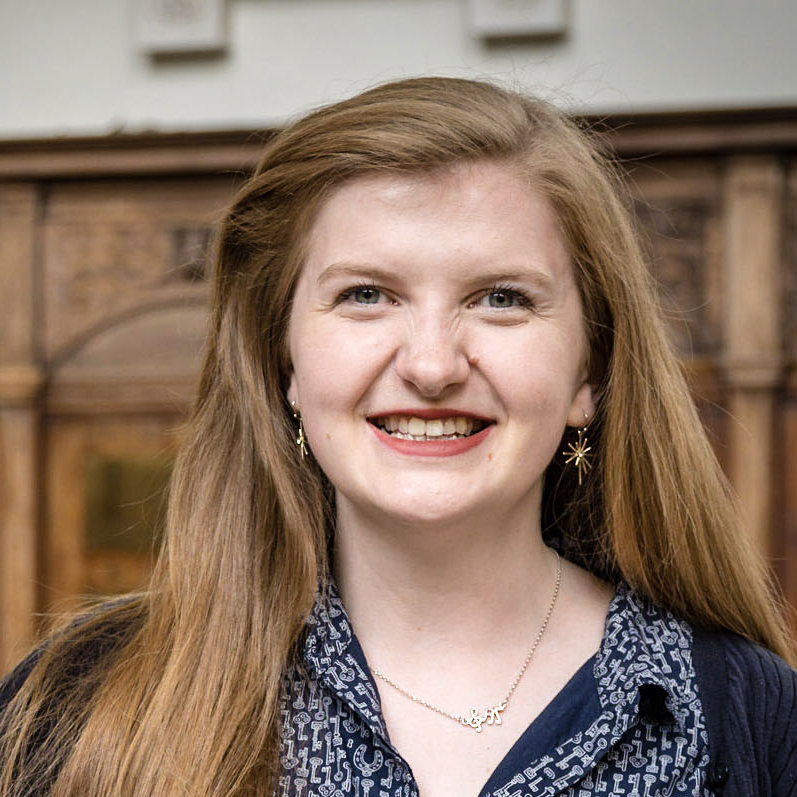
Holly
“Each person brings their own unique gift to the sound, to create something genuinely exciting.”
Read our Q&A with Holly
What do you enjoy most about being in TCC?
If I had to narrow it down amongst all the wonderful things that I love about TCC, I would say that I find the most joy in the amazing final product we manage to produce and being able to see how far we have come with the repertoire, and then being able to share it with more people. Singing with your friends at least three times a week is a rare special aspect of the week, even during the most packed, stressful times of term. TCC really is like a family unit, with different kinds of people all brought together by a shared love for the music we make. Each person brings their own unique gift to the sound, to create something genuinely exciting and musically outstanding, even on a cold, rainy Tuesday!
How do you find the commitment of being a choral scholar alongside your academic study?
Even alongside a music degree, I have found the commitment a refreshing break from academic music. It is not as intense as other degree courses, but that is not to say that by third year there is an awful lot of work! It is no secret that a Cambridge degree puts significant demands on your time and attention, but it is a great thing to be finished for the day and join others in singing. Balancing a choral scholarship with your academic study is completely possible, and the way the experience enhances your time at university is like little else.
What has been your musical highlight of being in TCC?
So far, there have been so many incredible moments, but if pushed, I would say it was the first full choir rehearsal post-pandemic. We were rehearsing the Duruflé Requiem in preparation for a Eucharist in commemoration of those lost to the pandemic; it was an amazingly moving moment getting to the climax of the ‘Kyrie’, with everyone singing their socks off, having had to be away from everyone for such an extended period. It was very emotional, and a moment I will remember and treasure forever.
Holly was interviewed in her third year at Murray Edwards (Summer 2022) when she was reading Music.
Choral Scholarship benefits
In addition to their annual scholarship of £100, Choral Scholars receive:
- Free singing lessons with our experienced and highly-respected teachers (see below);
- Three free dinners a week in Hall and six annual feasts;
- Annual > tours at no cost to the individual Choral Scholar;
- Accommodation, food and travel expenses for Choir projects outside term;
- Electronic pianos for use in own individual room;
- Access to College funds for personal instrumental lessons;
- Access to subsidised Yoga and Pilates sessions in College.
Singing teachers
Choral Scholars and Volunteers and Organ Scholars all receive six free singing lessons per term from one of our experienced and highly-respected singing teachers.
All of our singing teachers are accomplished singers in their own right with a wealth of professional experience as soloists and ensemble singers.
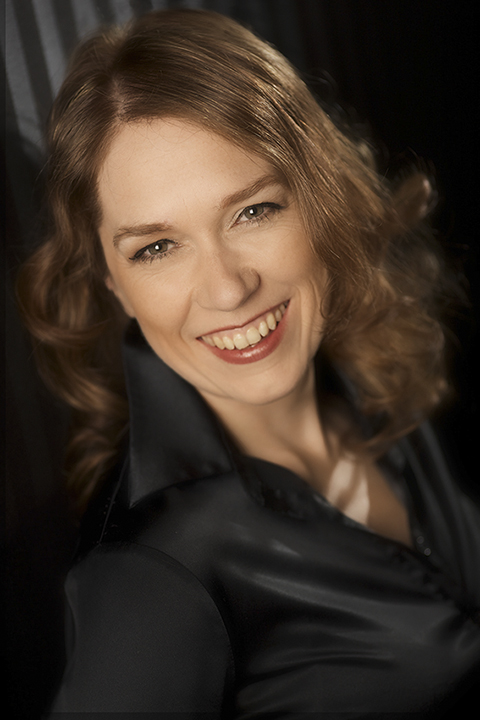
Ann de Renais
Ann de Renais is a Belgian soprano, singing teacher, piano teacher and song writer.
She holds a BMus(Hons) from the Royal Conservatoire Brussels, a BA(Hons) Singing from Luca-Arts in Leuven, and Certificates of Post-Graduate Studies and Teaching Technique from the Guildhall School of Music and Drama.
Read more
1996 marked her first visit to the voice teacher David L. Jones in New York City, and the start of her studying Mr Jones’s Swedish-Italian School of Singing. She became his associate singing teacher in the UK in 2002 and continues her teacher training with him on a regular basis.
Ann’s singing career started as first soprano with the five-time Grammy award-winning vocal group The Swingle Singers with whom she performed at venues including La Scala, the Lincoln Center, and the Berliner Philharmoniker. As a soloist, she has sung many opera roles, oratorio, and song recitals, and music by contemporary composers including Luciano Berio, the late Sir John Tavener and Peter Eötvös. Her versatile voice has seen her contribute as a session singer to over 200 film scores, including Harry Potter, James Bond, The Lord of The Rings, and The Hobbit. She was the UK and worldwide soloist of The Lord of The Rings – Live to Screen performances with orchestra from 2007 to 2012.
Her songwriting with co-writer Ben Parry began in 2015 and her songs can be heard on radio and television, The Syndicate, National Geographic Channel, the Antiques Roadshow and others. She teaches singing and piano privately in London and at St Christopher’s School for Girls in Hampstead.
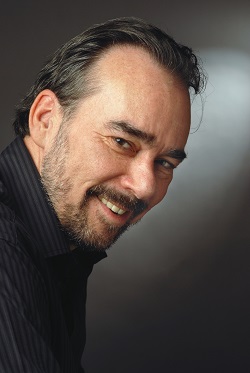
Roderick Earle
Roderick Earle was born in Winchester, where he was a chorister in the cathedral choir. In 1974 he graduated from St John’s College, Cambridge where he read Music and was a Choral Scholar under George Guest.
He was then awarded a Foundation Scholarship to the Royal College of Music and studied on the Opera Course, later continuing his studies with Czech baritone, Otakar Kraus.
Read more
He went on to being awarded a Greater London Arts Association Musician of the Year Award, and, after making his opera debut with English National Opera in 1978 and then joining the company for two years, he joined the Royal Opera at the age of 28, making his Covent Garden debut as Antonio in Le Nozze di Figaro in 1980 with Sir Colin Davis. He was a member of the company for 21 years, during which time he made the transition from bass to baritone, and sang over 60 roles.
He has a wide experience of concert work which has included singing the bass solos in Monteverdi Vespers with Sir John Eliot Gardiner at the start of his career through the Classical and Romantic repertoire. He has been fortunate to sing with some of the greatest conductors of the age not only at Covent Garden but also on the South Bank and abroad.
Roderick has taught singing for more than 25 years. As well as being a singing professor at the Royal College of Music (since 1990) he runs workshops, which include coaching in language (French, German, Italian and different pronunciations of Latin), style, communication and stage craft. He has been a tutor on a regular basis for the last 12 years at the East Anglia Summer Music School in Norwich and taught in New Zealand and Singapore. In 2010 he founded The Colchester Chamber Choir of 30 auditioned voices which specialises in pre-baroque and 19th and 20th century a cappella choral repertoire. He now also directs a chamber choir for the McKinsey European Music Festival in Kitzbühel, Austria each summer.
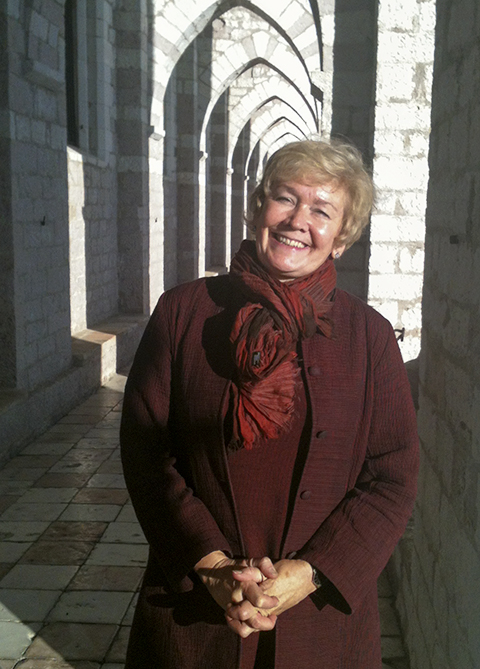
Sheila Barnes
Sheila Barnes trained at the Yale School of Music, where she took both a Masters and a Master of Musical Arts degree.
Since coming to live in the UK in 1991, she has maintained a thriving London private teaching practice, in which she is sought after by professional singers from the UK, Spain, Switzerland, Germany, the Netherlands, Latvia, Luxembourg and Belgium, as well as teaching Choral Scholars at Trinity.
Read more
Her private singing pupils perform regularly as soloists at English National Opera, The Royal Opera House (Covent Garden), Glyndebourne, Scottish Opera, Welsh National Opera, Opera Holland Park, Opera North, English Touring Opera, Garsington Opera, The Royal Netherlands Opera, and ReisOpera (the Netherlands), as well as with consorts such as Exaudi, The Sixteen, The Tallis Scholars, The Cardinall’s Musicke, and the Temple Church in London, at St Paul’s Cathedral, and at Westminster Abbey.
Sheila acted as Vocal Consultant to the Oper Kiel (Germany) for four seasons, teaching private lessons for the soloists, members of the permanent company. She maintained a studio for eight years in Holland, in The Hague, where she developed her individual approach to teaching singing.
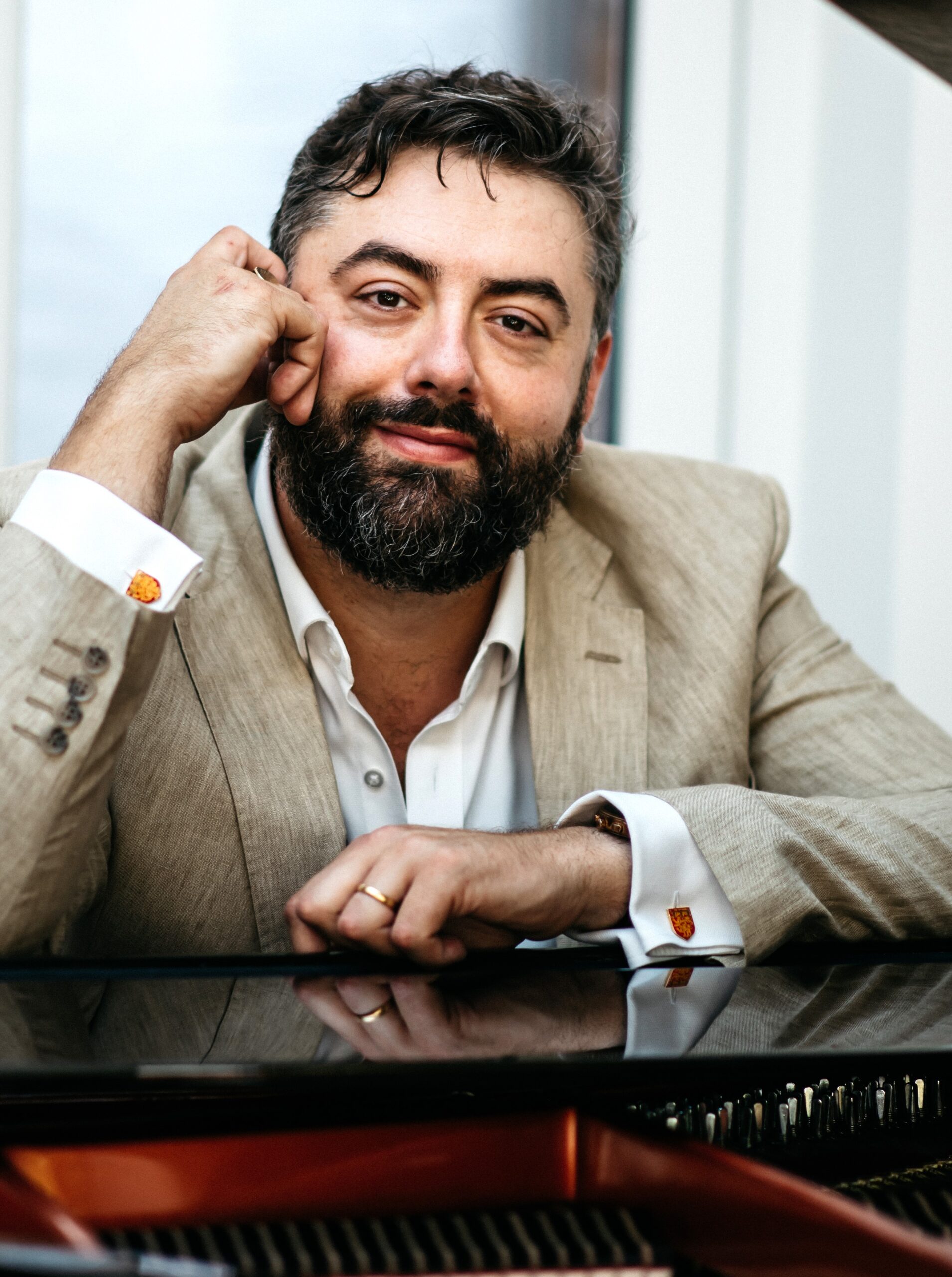
James Oldfield
The bass-baritone James Oldfield was born in Ipswich and was a chorister at Leicester Cathedral.
He subsequently held a Choral Scholarship at Trinity College, Cambridge, where he read Geography, and then a Lay Clerkship at St John’s College, Cambridge. James then held scholarships at the Royal College of Music and the RCM International Opera School, and studied with Ashley Stafford and Graeme Broadbent. His awards included the Eric Shilling Prize, the inaugural Independent Opera Award, and a Sybil Tutton Award from the Musicians’ Benevolent Fund.
Read more
He has a wide experience of oratorio and operatic work. James’ solo concert appearances include performances with London Symphony Orchestra, Philharmonia, RTÉ Symphony Orchestra, RTÉ Concert Orchestra, Irish Baroque Orchestra, Hallé, Manchester Camerata, Royal Philharmonic Orchestra, De Belgische Kamerfilharmonie, and Northern Sinfonia. His recordings include Handel Messiah with the Huddersfield Choral Society and Monteverdi Vespers. James’ operatic performances have been for Opera North, Garsington, Gothenburg Opera, Israeli Opera, and Royal Opera House 2. In 2010, he received the Leonard Ingrams Award from Garsington Opera after his professional debut as the title character in Le Nozze di Figaro.
James conducts an annual partsong and madrigal course at Benslow Music. He is passionate about young people singing, and teaches regularly for the National Youth Choir of Great Britain, Rodolfus Choral Courses, the National Youth Choir of Wales, and Gabrieli Roar. He teaches singing privately, and at Tiffin School near his home in Surrey.